
Young Children With Bikes And Scooters In Park

The Role of Child Care in the North Carolina Economy

On February 15, 2024, the Centralina Economic Development District guided an interactive discussion between economic developers, child care providers and local government employees and officials to develop actionable solutions and uncover best practices.  See below for the resources that were presented at the event. Click here to view the slides from that presentation.

Child Care and the North Carolina Economy

At the core of economic development is a valuable commodity that is often overlooked: childcare. It’s like a secret ingredient enhancing the flavor of our communities for today and the future. Recently, the Centralina Economic Development District hosted a pivotal discussion with regional childcare partners, focusing on the role of childcare in the North Carolina economy. To help better understand the complexity of the issue, the event sought to unravel the urgency of the childcare crisis while sparking actionable strategies for local governments, economic development organizations and their allies.

Burden of Cost

Across North Carolina, young families grapple with the problem of childcare costs. In our region, annual expenses vary dramatically, ranging from $5,051 for a school-age child to a staggering $15,538 for an infant. These figures represent the stark reality faced by families trying to provide a basic necessity for their children. What’s even more concerning is that childcare emerges as one of the most significant financial hurdles families must face, and it often comes during the early phases of a parent’s career, when earnings tend to be lower.  With annual costs for infant care averaging $11,467, it surpasses the expense of in-state tuition at a 4-year North Carolina public college, standing at $7,354. The disparity is glaring and emphasizes the financial strain that affects numerous households across the state.

In addition, while Federal ARPA funds have offered temporary relief, totaling $1.3 billion since 2021, this lifeline is set to expire in June 2024. The subsequent decrease in federal funding to $400 million casts uncertainty over the childcare landscape in North Carolina.
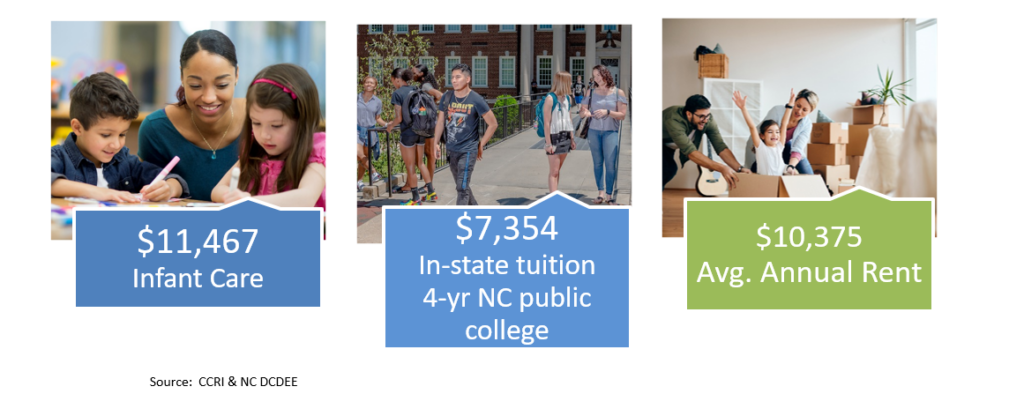
Expense of childcare costs compared to college
Workforce Challenge 

Childcare programs are dealing with issues of retaining teachers and maintaining operational stability.  Early childhood educators, earning approximately $14 per hour, find themselves at a crossroads. The lure of higher wages in the retail sector, ranging from $18 to $20 per hour, paired with comprehensive benefits packages, draws many educators away from the profession. This constant departure threatens not only the strength of the childcare workforce but also the quality of care provided to our children.

Government Action and Community Resilience

 In the face of these challenges, local and county governments must rise to the occasion. They must recognize early care and education as critical components of the infrastructure necessary for their community to prosper and thrive. By embedding a culture of family-friendliness into planning policies and practices, they can pave the way for a brighter future. Additionally, it’s imperative for governments and community leaders to proactively identify and address barriers that hinder access to childcare services and increase rising costs. Collaboration between government entities, childcare providers, and community stakeholders is essential to forging a path forward that prioritizes the well-being of our children and the sustainability of our economy.

The childcare crisis in North Carolina is not just a financial concern; it’s a public priority that demands attention and action. As we continue to promote economic growth, it is crucial to not overlook the foundational role childcare plays in shaping the future workforce and fostering community resilience. Together, through collaboration and commitment, we can nurture a brighter tomorrow for generations to come.

Curated Child Care Resource Links for Communities in the Centralina Region

REGIONAL

Child Care Demographic Fact Sheets for Each Centralina County (might be slow to load)

Read More
cog

Fostering Regional Prosperity: Centralina EDD’s Commitment to Economic Growth

The Centralina Economic Development District (EDD) has released its Annual Update for the Comprehensive Economic Development Strategy (CEDS) as required by the U.S. Economic Development Administration (EDA). This strategic plan, developed in collaboration with stakeholders across the greater Charlotte region, outlines a vision for the future called “Prosperity for All.” The plan focuses on three core themes—people, place and economy—with corresponding goals to expand economic opportunity, build supportive infrastructure, and strengthen regional resilience and global competitiveness.

Significant progress has been made in advancing the CEDS, which is great news for regional and local economic growth. The strategy covers a range of recommendations, such as workforce development, community support, regional mobility and global competitiveness. You can visit the Centralina EDD visual dashboards designed to track the progress on expanding economic opportunities.

Advancing Action Items

The Centralina EDD has been moving the needle on various action items. Here are a few achievements and their corresponding CEDS action item.

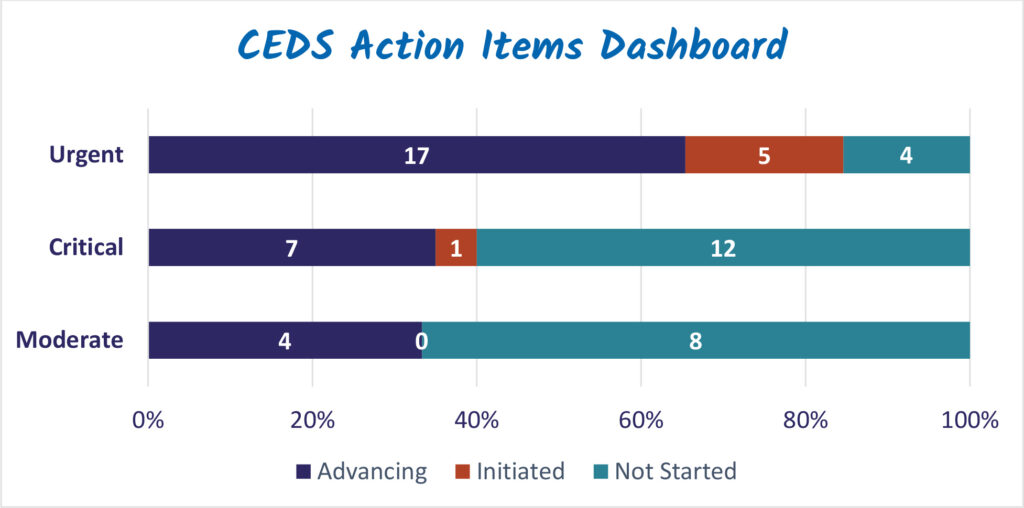
The CEDS has defined 58 action items with a timeline for completion. These action items are categorized as Urgent, Critical and Moderate, and their initiation deadlines are June 2024, June 2025 and June 2027, respectively. The progress of these action items has been closely monitored, and it has been observed that some of them are advancing while others are waiting to begin. Out of the 58 action items, 28 are currently making progress, which is a positive sign that the strategic planning initiated by the Centralina EDD Board in late 2021 is contributing to the success of the initiative.

Highlights & Success Stories October – December 2023
Regional Engagement
  • Four targeted virtual job fairs were organized for local government, education, manufacturing, flexible schedule/remote employment. Goal 1 – 2.2
  • Centralina EDD presented childcare research to statewide EDD coordinators in preparation for the February event. Goal 1 – 3.1
  • Rowan County Manufacturers Network collaborated with local manufacturers, Centralina and Commute with Enterprise program to explore solutions for workforce mobility to employment centers. Goal 2 – 1.1
  • CONNECT Beyond is forming a task force of stakeholders to examine connected and autonomous vehicles and their technology. Goal 2 – 1.3
  • Centralina received a Regional Infrastructure Accelerator grant from the US DOT for CONNECT Beyond implementation, including building an Integrated Mobility Center and building out project service lines for finance innovation, pipeline project facilitation and transit-orientated development. Goal 2 – 3.2
  • Centralina Community Economic Development staff developed a resource addressing stormwater management specifically for local government pre-development meetings. Goal 2 – 3.4
  • Centralina was referenced for Affordable Housing best practice initiatives by the National Association of Development Organizations. Goal 2 – 4.1
  • Exploring supply chain council with Charlotte Regional Business Alliance through NC Manufacturing Extension Partnership. Goal 3 – 2.1
Grant Support
  • UNC Charlotte was awarded an EDA Tech Hub Strategy Development Grant and the Centralina EDD team participated in the application process. Goal 3 – 4.1
  • Provided a letter of support for South Piedmont Community College to create a career center focused on advanced manufacturing training and employment. Goal 1 – 2.4

Read More
World Management Team in office silhouette

2024 Meeting Agendas & Minutes

This page includes agendas, meeting links and related documents for all Centralina Economic Development District (CEDD) Board meetings conducted in 2024. Materials are provided to support public access and regional governance.

 Please contact swatkins@centralina.org with any questions.

2024

January 18 I Agenda Packet | Minutes

April 18 I Agenda Packet | Minutes

June 20 I Agenda Packet | Minutes

October 17 I Agenda Packet | Minutes

Read More
Downtown Kannapolis 2020

Celebrating Centralina’s 55th Anniversary with The City of Kannapolis

UNC-Charlotte leads the consortium in partnership with the Charlotte Regional Business Alliance and the Centralina Regional Council.

Read More
Pin_board

Comprehensive Economic Development Strategy 2023 Update

The Centralina Economic Development District (EDD) is thrilled to share the progress made in 2023 towards implementing the region’s Comprehensive Economic Development Strategy (CEDS). Guided by the “Prosperity for All” vision, this strategy emphasizes collaboration to create a more inclusive and globally connected future for the greater Charlotte region.

In 2023, significant strides were made across the three core goals: expanding economic opportunity, building supportive infrastructure, and strengthening regional resilience. With 58 action items identified, including 26 marked as urgent, the Centralina EDD and its partners have already initiated 34 of these initiatives. Efforts include hosting targeted job fairs, supporting workforce development through education partnerships, and advancing regional mobility through the Connect Beyond plan.

Looking ahead, Centralina EDD remains committed to fostering economic growth and equity across the region, leveraging partnerships and innovation to ensure long-term prosperity for businesses, workers, and communities.

Visit CentralinaEDD.org to learn more and stay updated on this impactful work!

Read More
EDA Awards Tech Hub Strategy Development Grant

EDA Awards Tech Hub Strategy Development Grant

UNC-Charlotte leads the consortium in partnership with the Charlotte Regional Business Alliance and the Centralina Regional Council.

Read More
textile1

Gaston College Receives $1.1 Million EDA Grant


Gaston College received a significant $1.1 million grant from the U.S. Department of Commerce Economic Development Administration (EDA) to support the addition of advanced manufacturing equipment in the newly constructed state-of-the-art Fiber Innovation Center (FIC) on the Kimbrell Campus in Belmont, N.C. (more…)

Read More
Community growth and social labor count increase graph tiny pers

What’s Ahead for the Centralina Region: Regional Data Trends

Centralina Regional Council focuses on addressing the needs of member communities in our nine-county area and working collaboratively on issues that impact our region, examining national, state and local trends impacting our member governments and identifying their potential impacts to determine best practices for meeting needs and addressing challenges. This brief dives into current regional trends and how they are currently being addressed by Centralina, including how the Centralina Economic Development District (CEDD) are working to support local economic development policy and adding to the region’s economic diversity. 

Read More
Futuristic factory and technology. Wide image for banners, adver

Comprehensive Economic Development Strategy 2023-2028

In 2022, the Centralina Economic Development District Board of Directors worked in partnership with Centralina Regional Council, the CEDS Steering Committee and a range of stakeholders to assess the region’s current economic conditions and develop a strategy to build on existing assets while addressing both short-term shocks and structural challenges to the economy. These findings were the building blocks of the 2023 – 2028 Prosperity for All CEDS, a five-year locally based, regionally driven economic development strategy to generate good jobs, diversify the economy and spur economic growth. 

Read More
AdobeStock_237287725 (1)

Prosperity Profile Technical Report (CEDS 2023-2028, Appendix A-C)

The Prosperity Profile creates a baseline set of metrics for the nine-county Centralina region to assess the state of equity. The Prosperity Profile directly informs the Comprehensive Economic Development Strategy and will also be used long-term to monitor the region’s progress on equity.

Read More
#thegov_search_6b089091d71b3:hover { color: rgba(50,110,147,1) !important; }